

The One Factor Driving Home Prices in Silicon Valley Right Now
You have probably seen conflicting headlines about home prices.
Some say prices are still rising. Others say the market is cooling. And some focus on the places where values have declined.
All of those stories can be true at the same time.
The reason is simple. Home prices are being shaped by one major local factor.
Inventory.
The number of homes available compared with the number of active buyers helps explain why prices are rising in some markets, holding steady in others, and declining modestly in a few.
Why Inventory Matters So Much
Home prices respond to supply and demand.
When fewer homes are available, buyers compete for a limited number of properties. That competition supports prices and can sometimes push them higher.
When more homes are available, buyers have choices. They can compare properties, take more time, and negotiate more carefully. Sellers then have less freedom to push prices beyond what buyers believe the home is worth.
That is why a national home price average does not tell the full story.
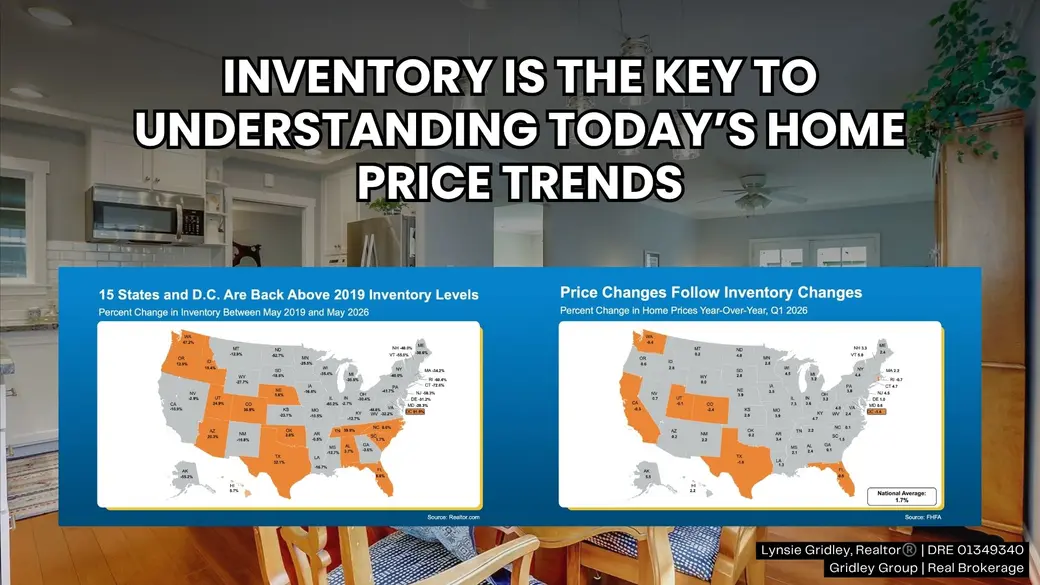
The Federal Housing Finance Agency reported that United States home prices rose 1.7 percent from the first quarter of 2025 through the first quarter of 2026. But prices increased in 42 states and declined in eight states and Washington, D.C.
The national number is an average of many different local markets.
Where Inventory Has Recovered, Prices Are Softer
Some markets now have as many homes for sale as they did before the pandemic, or even more.
In those areas, buyers have more leverage. Homes may take longer to sell, sellers may reduce their asking prices, and price growth can flatten or turn slightly negative.
The June 29 housing update points to parts of Texas, Florida, and Colorado as examples of places where inventory has risen above 2019 levels and home prices have softened.
This does not necessarily mean those markets are crashing.
It means supply has caught up with, or moved ahead of, current buyer demand.
Where Inventory Remains Limited, Prices Have More Support
Other markets still have considerably fewer homes available than they did before the pandemic.
When supply stays tight, buyers continue competing for a limited number of listings. That helps support home values, even when mortgage rates and affordability reduce the number of active buyers.
Nationally, available inventory remained 12.5 percent below typical 2017 through 2019 levels in April 2026.
That continuing shortage is one reason broad home price declines have not spread across the country.
What This Means for Silicon Valley
Silicon Valley has always been highly local.
The number of homes for sale can vary considerably between cities, neighborhoods, property types, and price ranges.
A remodeled home in a sought-after neighborhood may face limited competition and attract several interested buyers.
A home needing substantial work, located in a less convenient setting, or listed in a price range with more available inventory may experience a much slower response.
That is why buyers and sellers should not rely on one regional or national headline.
The most useful questions are:
- How many comparable homes are currently available?
- How many have recently gone under contract?
- How long are similar homes taking to sell?
- Are prices being reduced?
- Are homes selling near, above, or below the asking price?
Those details reveal whether supply or demand currently holds more influence.
What Buyers Should Know
For buyers, inventory determines how much flexibility you may have.
When several comparable homes are available, you may have more time to evaluate the property and more room to discuss price or terms.
Potential opportunities may include:
- A lower purchase price
- Repair credits
- Help with eligible closing costs
- A lender-approved mortgage rate buydown
- Included appliances
- Flexible closing terms
But when inventory is tight and a desirable home attracts immediate interest, buyers may need to act more decisively.
That does not mean abandoning good judgment or protections. It means understanding the competition and building an offer that reflects the actual market.
What Sellers Should Know
For sellers, inventory should influence the entire listing strategy.
If your home has little direct competition, you may be in a favorable position. But that does not mean any price will work.
Buyers remain sensitive to monthly payments and value. Even in a low inventory market, a home can sit if the asking price is disconnected from the condition and recent sales.
When more comparable homes are available, sellers need to work harder to stand out.
That may mean:
- Pricing accurately from the beginning
- Completing visible repairs
- Improving staging and presentation
- Using strong photography and video
- Responding thoughtfully to buyer feedback
- Remaining open to reasonable negotiation
Realtor.com’s recent research emphasizes that initial pricing can determine whether a home attracts competing offers or requires a later price reduction.
Why National Headlines Can Be Misleading
A headline saying home prices are rising may be true nationally while prices are declining in a particular city.
A headline about falling prices may describe a small group of markets with unusually high inventory.
Neither headline necessarily describes your neighborhood.
That is why local inventory is so important.
It connects the larger housing story to the specific market where you plan to buy or sell.
This Is Not One Housing Market
The United States does not have one uniform housing market.
It has thousands of local markets responding differently to supply, demand, employment, affordability, migration, and new construction.
The FHFA data shows that prices rose in most states during the latest annual period, but the rate of change varied widely. Illinois led the country with 7.3 percent annual growth, while Colorado experienced a 2.4 percent decline.
That is a wide range.
The difference is not random. Inventory is one of the most important explanations.
Bottom Line
Inventory is the main factor explaining why home prices are moving differently across the country.
When homes are scarce, prices tend to receive more support.
When buyers have many choices, price growth tends to slow, and sellers may need to negotiate.
In Silicon Valley, the right strategy depends on the supply and demand surrounding the specific property, neighborhood, and price range.
The national headline is useful context. The local inventory tells you what is actually happening.
Recent Posts





Her expert knowledge, negotiation, and marketing skills combined with her high level of commitment provide a framework for lasting relationships. Lynsie commits to “Bringing you the Best!”