

Who Has the Upper Hand in Silicon Valley Real Estate Right Now?
Is this a buyer’s market or a seller’s market?
It sounds like a simple question. In 2026, it is not.
Nationally, buyers have gained leverage as more homes have come onto the market. But Silicon Valley is a good example of why national labels can be misleading. Depending on which local metric you look at, buyers may have more choices while sellers of well-positioned homes still have meaningful leverage.
The better question is not simply who has the upper hand.
It is who has the upper hand for this particular home, in this particular neighborhood, at this particular price?
Nationally, the Market Has Become More Balanced
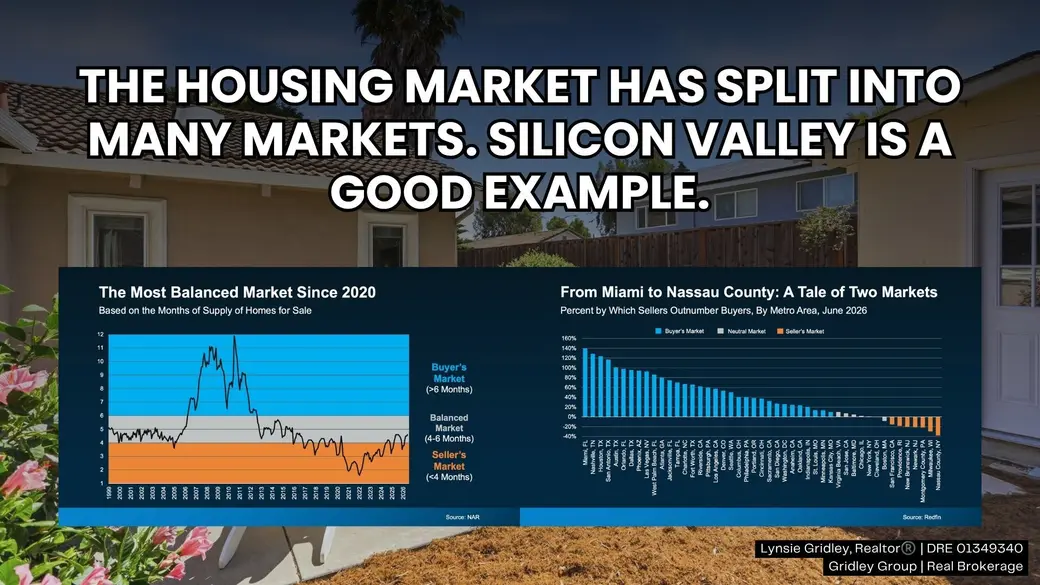
One useful measure of market leverage is months of supply.
Months of supply estimates how long it would take to sell the homes currently available if no additional homes came onto the market.
A commonly used framework is:
- Fewer than 4 months tends to favor sellers
- 4 to 6 months is more balanced
- More than 6 months tends to give buyers greater leverage
The National Association of Realtors reported a 4.6-month supply of existing homes nationally in July. That is a much more balanced environment than the extremely tight inventory buyers experienced earlier this decade.
Redfin’s newest data goes even further. In July, it estimated that sellers outnumbered buyers nationally by 51.3%, and 39 of the 49 major metro areas it analyzed qualified as buyer’s markets under its methodology.
So yes, buyers have more leverage in much of the country.
But that does not automatically tell us what is happening in Silicon Valley.
Silicon Valley Is More Complicated
Here is where local data gets interesting.
Redfin’s July analysis classified the San Jose metro as a buyer’s market, estimating 18.8% more sellers than buyers.
But C.A.R.’s latest county data shows Santa Clara County with only 1.7 months of unsold inventory in June and a median market time of just 11 days.
Those numbers seem contradictory at first.
They are not necessarily.
Redfin is comparing its estimated number of buyers with active sellers across a metro area. C.A.R.’s months-of-inventory calculation measures how quickly the available supply of single-family homes is being absorbed in Santa Clara County.
Different geography. Different methodology. Different lens.
Together, they tell us something useful: buyers may have more options and negotiating room than they did during the most competitive years, but Silicon Valley inventory can still be tight enough for desirable homes to move quickly.
Competitive Homes Are Still Competitive
We have another data point that helps complete the picture.
In May, 53.2% of San Jose area homes tracked by Redfin sold above their original asking price, making San Jose one of the most competitive large housing markets in the country by that measure.
That does not mean every home is receiving multiple offers.
Far from it.
A thoughtfully prepared home in a desirable location may attract immediate interest. Another property a few streets away may sit because of condition, location, price, layout, or simply because buyers see better alternatives.
That is why broad labels such as “buyer’s market” and “seller’s market” have become less useful on their own.
What Buyers Should Take From This
The good news is that buyers have more room to be thoughtful.
There may be opportunities to negotiate price, credits, repairs, timing, or other terms on certain properties.
But more negotiating power does not mean every seller is negotiable.
Watch what the individual listing is telling you.
How long has it been on the market?
Has the price changed?
How does it compare with recent sales?
Are there competing offers?
Are similar homes sitting while this one is attracting immediate attention?
The answers should shape the offer.
A buyer who assumes every property is negotiable can lose a good home. A buyer who assumes every home requires an aggressive over-asking offer can unnecessarily give away leverage.
What Sellers Should Take From This
The market is less forgiving of optimistic pricing.
Buyers have more choices nationally, and even locally there are properties competing for their attention.
That makes the initial pricing strategy important.
The goal is not simply to put a high number on the home and see what happens. It is to position the property against the actual alternatives buyers are considering.
Preparation matters for the same reason.
Condition, staging, photography, marketing, access, and pricing all influence whether buyers see a home as one they need to act on or one they can come back to later.
The Silicon Valley Market Is Becoming More Property Specific
The days when almost every home benefited equally from extremely limited inventory are behind us.
But that does not mean leverage has simply shifted from sellers to buyers.
Silicon Valley remains a collection of smaller markets.
Price point matters. Neighborhood matters. Condition matters. Schools, lot size, location, floor plan, and competition matter.
And increasingly, the individual property matters.
The Bottom Line
Nationally, buyers have gained meaningful leverage.
Here in Silicon Valley, the picture is more nuanced.
Buyers generally have more choices and may have more room to negotiate. At the same time, Santa Clara County inventory remains relatively tight, and strong properties can still attract significant competition.
So who has the upper hand?
Sometimes the buyer.
Sometimes the seller.
And increasingly, the answer depends on the home in front of you.
Recent Posts





Her expert knowledge, negotiation, and marketing skills combined with her high level of commitment provide a framework for lasting relationships. Lynsie commits to “Bringing you the Best!”