
Thinking About Waiting for Lower Mortgage Rates? Silicon Valley Buyers Should Read This First
If you are thinking about buying a home, mortgage rates are probably one of the biggest things on your mind.
That is understandable.
Rates affect your monthly payment, your buying power, and how comfortable the numbers feel. And in Silicon Valley, where home prices are already higher than the national average, even a small rate change can matter.
But here is the part buyers sometimes miss.
Waiting for the perfect rate may not create as much savings as you expect, and it could mean missing the right home while you wait.
Rates Are Still Moving Around
Mortgage rates have not followed a straight line this year.
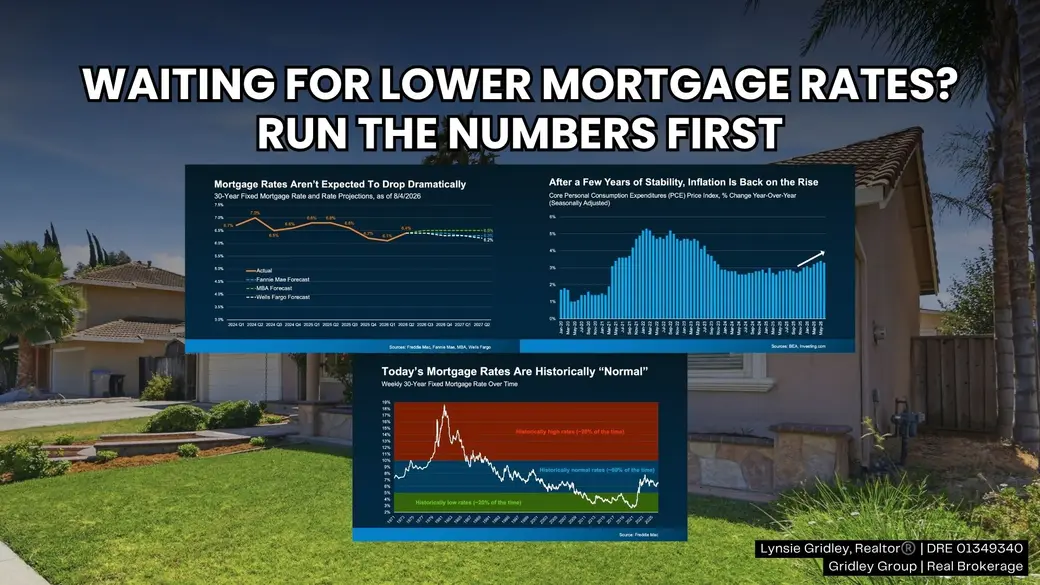
Freddie Mac reported that the average 30-year fixed mortgage rate was 6.69 percent as of August 6, 2026, up slightly from 6.66 percent the week before. A year earlier, the average was 6.63 percent.
That means rates are still elevated, and they are still influencing affordability.
But it also means buyers waiting for rates to fall dramatically may need to be realistic.
Rates can dip for a short time, then rise again. If the right home appears during that window and you are not prepared, it can be hard to move quickly.
The Difference May Be Smaller Than It Feels
A rate starting with a 5 feels very different from a rate starting with a 6.
Psychologically, that is a big line for many buyers.
But the payment difference may not always be as dramatic as it feels.
The article gives a simple example. On a $500,000 loan, moving from a 6.1 percent interest rate to 5.9 percent changes the estimated principal and interest payment from about $3,030 to about $2,966. That is roughly $64 per month.
That money matters.
But for many buyers, the bigger question is not whether the rate starts with a 5.
The bigger question is whether the full monthly payment fits comfortably today.
The Full Payment Matters More Than the Rate Alone
A mortgage rate is only one part of affordability.
Your full monthly housing cost may include:
- Principal and interest
- Property taxes
- Homeowners insurance
- HOA dues, if applicable
- Mortgage insurance, if applicable
- Utilities
- Maintenance
- Reserves for repairs
In Silicon Valley, buyers should be especially careful to look at the full number, not just the interest rate.
A lower rate can help, but the purchase price, taxes, insurance, and long-term maintenance can have just as much impact on comfort.
Forecasts Do Not Point to a Big Immediate Drop
No one can predict mortgage rates perfectly.
Rates are influenced by inflation, the bond market, Federal Reserve policy expectations, global events, and broader economic conditions. AP reported that mortgage rates generally follow the direction of the 10-year Treasury yield, which lenders use as a guide when pricing home loans.
Fannie Mae’s forecast page also makes clear that its mortgage and housing outlooks are based on assumptions and can change as the economy changes.
That is why building a buying plan around a specific future rate can be risky.
Rates may improve. They may not. They may dip briefly and then move back up.
The better strategy is to understand what you can afford now, then stay ready if conditions improve.
Waiting Can Have a Cost Too
Waiting for a lower rate may feel safe, but it is not always cost-free.
While you wait, a few things can happen:
- The home you want may sell
- Inventory may change
- Prices may move
- Competition may increase if rates fall
- Your rent may continue
- Your personal circumstances may shift
If rates drop meaningfully, more buyers may reenter the market at the same time. That can increase competition for the best homes.
So even if the rate improves, the overall buying experience may not become easier.
What This Means for Silicon Valley Buyers
Buying in Silicon Valley is not about rushing.
It is about preparation.
If you are waiting only because you want a lower rate, it may be time to run the numbers again.
Ask your lender to show you:
- Your payment at today’s rate
- Your payment if rates drop slightly
- Your payment if rates rise slightly
- The effect of buying down the rate
- The effect of a different down payment
- The effect of seller credits, when available
- The full monthly cost with taxes and insurance
That comparison can help you decide whether waiting is truly necessary or whether the right home could already make sense.
What About Refinancing Later?
If you buy now and rates fall later, refinancing may be an option.
But refinancing is not guaranteed.
It depends on future rates, your loan, your equity, your credit profile, closing costs, and lender requirements.
That means buyers should not purchase a home they cannot comfortably afford today simply because they hope to refinance later.
A refinance can be a future benefit. It should not be the only reason the purchase works.
What Sellers Should Understand
This topic matters for sellers too.
Some buyers are still waiting for lower rates. Others are deciding they cannot keep waiting and are moving forward when the right home appears.
That means sellers need to position their homes carefully.
A home that is priced well and presented clearly can still attract serious buyers. But buyers are payment sensitive, and they are comparing value closely.
In some cases, a seller credit or rate buy-down strategy may help a buyer bridge the gap, if approved by the lender and structured correctly.
Bottom Line
Waiting for lower mortgage rates may feel like the safest plan, but it may not always create the savings buyers expect.
The better question is not, “Will rates fall?”
The better question is, “Does the full monthly payment work for me today?”
For Silicon Valley buyers, the right move starts with a clear look at the numbers, the local market, and your long-term goals.
If the home, payment, and timing make sense, waiting for the perfect rate may not be necessary.
Recent Posts


Her expert knowledge, negotiation, and marketing skills combined with her high level of commitment provide a framework for lasting relationships. Lynsie commits to “Bringing you the Best!”