
Down Payments Are Getting Smaller. What Silicon Valley Buyers Should Know
Saving for a down payment can feel like the biggest barrier between you and homeownership.
That is especially true in Silicon Valley, where even a modest percentage of the purchase price can represent a substantial amount of money.
But recent data offers some encouraging news.
The typical down payment has fallen to its lowest level in several years, and more buyers are using loan programs and assistance options that do not require 20 percent down.
That does not make buying inexpensive. But it may mean the amount you need to save is different from what you assumed.
The Typical Down Payment Fell Sharply
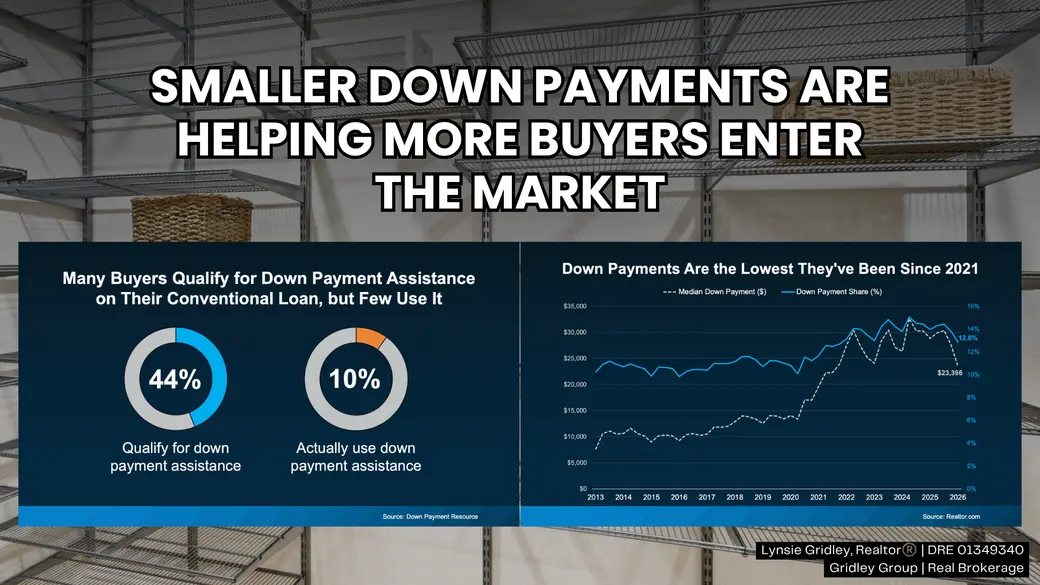
According to Realtor.com, the median down payment during the first quarter of 2026 was $23,400, or 12.8 percent of the purchase price.
That was 19 percent lower than one year earlier and the lowest median down payment since the third quarter of 2021. Realtor.com also found that down payment amounts and percentages had declined for four consecutive quarters.
The latest monthly figures showed some seasonal movement upward. In April, the typical down payment was $25,000, compared with $27,500 one year earlier.
The important point is not that every buyer now needs only $23,400.
Silicon Valley home prices are much higher than the national median, so local dollar amounts may be considerably larger.
The broader takeaway is that buyers are not necessarily putting down as much as they were a year ago.
Why Down Payments Are Getting Smaller
Several changes are contributing to the trend.
First, buyers generally have more choices than they had during the most competitive years. With less pressure to outperform several other offers, some buyers no longer feel they need an unusually large down payment just to be considered.
Second, home price growth has cooled nationally. Because a down payment is usually calculated as a percentage of the purchase price, slower price growth can reduce the total cash required.
Third, more buyers are using government-backed mortgage options.
Realtor.com reports that FHA and VA loans now represent more than one third of purchase mortgages. VA loans recently reached their highest share in more than a decade.
You May Not Need 20 Percent Down
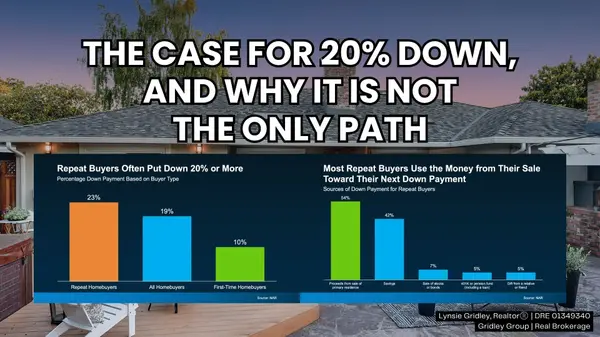
The idea that every buyer needs 20 percent down is one of the most persistent homebuying misconceptions.
A larger down payment can reduce the loan balance and may help lower the monthly payment. But it is not the only path to purchasing a home.
Depending on eligibility and lender requirements, buyers may explore:
Conventional loans with a lower down payment
FHA financing
VA financing for eligible Veterans and service members
Down payment assistance programs
Gift funds from qualifying family members
Each option has different rules, costs, mortgage insurance requirements, and qualification standards.
A lower down payment can help you purchase sooner, but it may also result in a larger loan and higher monthly cost. The full payment needs to remain comfortable.
Down Payment Assistance Is Often Overlooked
Down payment assistance is not one single program.
It includes thousands of state, local, nonprofit, employer, and housing finance agency programs. Assistance may take the form of a grant, forgivable loan, deferred loan, or second mortgage.
Eligibility can depend on income, location, occupation, household size, loan type, and whether the buyer has owned a home recently.
Older Urban Institute research found more than 2,500 active assistance programs nationwide and showed that eligibility varies considerably by metropolitan area and borrower circumstances.
The important lesson is that buyers should not assume they earn too much, have owned before, or are otherwise ineligible without checking.
Some programs are designed for first-time buyers. Others are not.
Local Income Limits May Be Higher Than You Expect
In a higher cost area like Silicon Valley, assistance program income limits may be different from what buyers expect.
Programs often use local area median income rather than one national standard. That means some households with solid professional incomes may still meet the requirements for certain programs.
Availability and rules change, so buyers should speak with a lender who actively works with assistance programs and can determine what is currently available.
A program is only helpful when the lender, property, loan, and buyer all qualify.
Family Help Is Playing a Larger Role
Some buyers are also receiving financial support from parents or other family members.
A 2026 Veterans United survey found that 59 percent of surveyed parents had helped or planned to help a child purchase a home. Down payment assistance was the most common reason, followed by help qualifying for a mortgage and covering closing costs.
Family assistance can take several forms, including:
A financial gift
Help with closing costs
Paying down debt before qualification
Allowing the buyer to live at home while saving
A properly documented family loan
Signing on the mortgage when permitted and appropriate
Any financial contribution needs to be discussed with the lender early.
Mortgage programs have specific documentation rules for gifts, loans, bank transfers, and account statements. Moving money without proper records can create delays during underwriting.
Families should also consult appropriate financial, tax, or legal professionals before committing substantial funds.
A Smaller Down Payment Is Not Automatically Better
The goal should not be to put down the smallest amount possible.
The goal is to find the right balance between upfront cash, monthly payment, reserves, and long-term financial comfort.
Spending less may allow you to preserve savings for:
Emergency reserves
Repairs and maintenance
Moving costs
Property taxes and insurance
Furniture or improvements
Unexpected expenses after closing
But a lower down payment generally means borrowing more. It may also involve mortgage insurance or other loan costs.
That is why buyers should compare several scenarios instead of focusing only on the minimum requirement.
What Silicon Valley Buyers Should Do
Start with a lender consultation before deciding how many years you need to save.
Ask for a comparison of:
Different down payment amounts
Monthly principal and interest
Property taxes and insurance
Mortgage insurance, when applicable
Closing costs
Available assistance programs
Required cash reserves
The long-term cost of each loan option
You may discover that buying requires less upfront cash than you thought.
You may also decide that waiting and saving more creates a more comfortable payment. Both can be reasonable conclusions.
Bottom Line
Down payments are smaller nationally than they have been since 2021, and more buyers are using financing options that require less cash upfront.
That does not mean every Silicon Valley buyer can purchase with the national median down payment. Local prices make the calculation different here.
But it does mean 20 percent down is not the only path.
A trusted lender can help you compare loan options, assistance programs, gift funds, monthly costs, and the amount of savings you should keep after closing.
You may be closer to buying than you realized.
Recent Posts



Her expert knowledge, negotiation, and marketing skills combined with her high level of commitment provide a framework for lasting relationships. Lynsie commits to “Bringing you the Best!”