

More Choices, Realistic Pricing, and Steady Rates: What Silicon Valley Buyers and Sellers Should Know
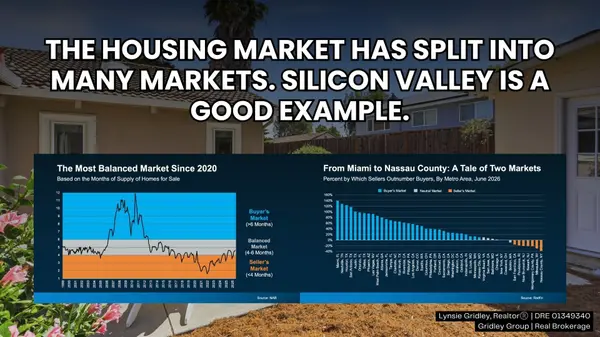
The housing market is becoming more functional.
That may not sound exciting, but after several years of unusually low inventory, rapidly changing mortgage rates, and big gaps between buyer and seller expectations, a more balanced market can be a good thing.
The August housing data points to three important trends: buyers have more choices nationally, sellers are adjusting their pricing, and large investors are buying fewer homes. Mortgage rates remain a challenge, but there are also more ways to approach affordability than simply waiting for rates to fall.
Here in Silicon Valley, the story is more nuanced. Inventory is still relatively tight, so buyers have gained some leverage without necessarily gaining the upper hand on every home.
More Homes Are Coming to Market
Nationally, new listings increased 2.4% year over year in June. Realtor.com counted more than 463,000 new listings during the month, making this the strongest spring for new listings since 2022.
That is good news for buyers who have spent the last few years frustrated by limited selection.
Sellers are also becoming more realistic. The national median asking price declined 2.5% from a year earlier in June, the eighth consecutive annual decline in Realtor.com data. Importantly, Realtor.com characterized the change as normalization rather than distress. Pending sales were still up 3.7% year over year.
In other words, homes are still selling. Buyers and sellers are simply having to meet each other closer to the middle.
Silicon Valley Is Still Tighter Than the National Market
National trends do not always translate directly to Silicon Valley.
C.A.R. reported just 1.7 months of unsold single-family home inventory in Santa Clara County in June. The median market time was 11 days.
That is still a limited supply.
The Santa Clara County median single-family sale price was $1.95 million in June, compared with $2.11 million one year earlier. A change in a county median should not be interpreted as the change in value of an individual property because the mix of homes sold changes from month to month.
For buyers and sellers, the more important point is that the market is becoming increasingly property-specific.
A well-priced, updated home in a desirable Silicon Valley neighborhood can still attract immediate attention. Another home that is priced ahead of the market may sit.
Buyers Have More Leverage, but It Depends on the Home
Nationally, seller concessions have become much more common. Redfin reported that 46.2% of sellers provided some form of concession in May. Those concessions can include contributions toward closing costs, repairs, or mortgage-rate buydowns.
But Silicon Valley is different.
Only 5.9% of San Jose transactions in Redfin's May dataset included a seller concession, one of the lowest rates among the major metros it tracked.
That is an important distinction.
A buyer should absolutely explore opportunities to negotiate, particularly when a home has been sitting or has already had a price adjustment. But assuming every Silicon Valley seller will provide a large credit could be just as unhelpful as assuming every home will receive multiple offers.
Look at the individual property.
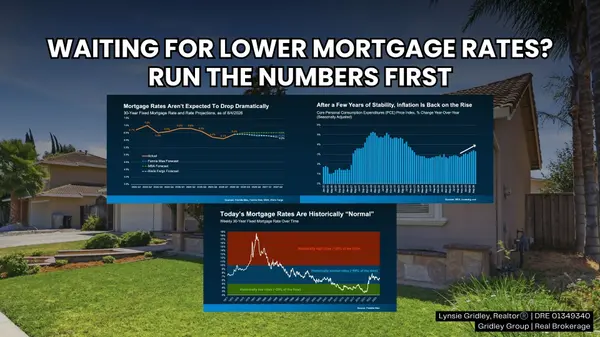
Waiting for 3% Mortgage Rates Is Not Much of a Strategy
Mortgage rates remain one of the biggest affordability challenges.
Freddie Mac reported that the average 30-year fixed mortgage rate was 6.67% as of August 13.
The August market report makes an important point about why rates have remained elevated.
Mortgage rates tend to move with the 10-year Treasury yield, plus a gap called the mortgage spread. That spread became unusually wide in 2023 but has since moved much closer to its historical average.
That means buyers should be cautious about building their entire plan around the assumption that mortgage rates will suddenly fall back to 3%, 4%, or even 5%.
Rates could move lower. They could also move higher. No one knows the exact path.
The more useful question is, "What can I comfortably afford under today's conditions?"
There Are Other Ways to Improve Affordability
Waiting is not the only option.
Depending on the property and the buyer's circumstances, strategies may include a seller credit, a mortgage-rate buydown, new construction incentives, or an adjustable-rate mortgage.
Each has different costs and risks. An adjustable-rate mortgage, for example, may offer a lower initial rate but can adjust later. Buyers should review financing options carefully with a qualified lender and understand the terms before deciding what fits their situation.
The goal is not to force a purchase.
It is to understand all the available options before assuming that lower market-wide mortgage rates are the only path forward.
Large Investors Are Buying Fewer Homes
There is another interesting shift happening nationally.
Redfin reported that investor purchases of single-family homes declined 6% year over year during the first quarter of 2026. Investor purchases of lower-priced homes fell 10%, reaching their lowest first-quarter level in a decade.
Among eight major institutional single-family landlords tracked by Parcl Labs, those companies sold 3,011 more homes than they purchased during the second quarter.
A new federal housing law also includes restrictions on large institutional purchases of single-family homes.
None of this means investors have disappeared from housing. Redfin reported that investors still accounted for 19% of the homes purchased in its first-quarter analysis.
But for buyers concerned that they are competing against an ever-growing wave of institutional money, the recent trend is worth understanding.
What This Means for Silicon Valley Buyers
The market may offer opportunities that were harder to find a few years ago.
There are more listings nationally. Sellers are paying closer attention to pricing. Some homes are creating room for negotiation. And large investors are buying fewer homes.
But Silicon Valley remains competitive enough that being prepared matters.
Know your comfortable payment. Have financing ready. Understand recent comparable sales. Then adjust your strategy to the property rather than applying one approach to every listing.
What This Means for Sellers
The lesson for sellers may be even simpler:
"Price for the market you are entering, not the market you remember."
Buyers are watching value closely.
In a market with high monthly payments, an aspirational price can make a home easier to pass over. Good preparation, thoughtful pricing, strong presentation, and clear marketing become more important when buyers have alternatives.
That does not mean sellers need to underprice their homes.
It means the pricing strategy should be grounded in current buyer behavior and current competition.
The Bottom Line
The 2026 housing market is slowly finding more balance.
That is good for healthy transactions.
Buyers have more choices and, in some situations, more negotiating power. Sellers can still achieve strong results when their homes are positioned well. Mortgage rates remain elevated, but waiting indefinitely for dramatically lower rates is not the only strategy available.
And here in Silicon Valley, the market remains local enough that the individual home often tells us more than the national headline.
Recent Posts




Her expert knowledge, negotiation, and marketing skills combined with her high level of commitment provide a framework for lasting relationships. Lynsie commits to “Bringing you the Best!”