

Is Silicon Valley Still a Seller’s Market? Here Is What the Data Says
A few years ago, sellers held nearly all the leverage.
Buyers often competed aggressively, offered above the asking price, and accepted limited room for negotiation just to secure a home.
Today, the national market looks very different.
More homes are available, buyers are taking more time, and negotiation has returned in many areas. But that does not mean every market has become a buyer’s market.
In fact, Silicon Valley continues to tell a more competitive story than many parts of the country.
The National Market Is Becoming More Balanced
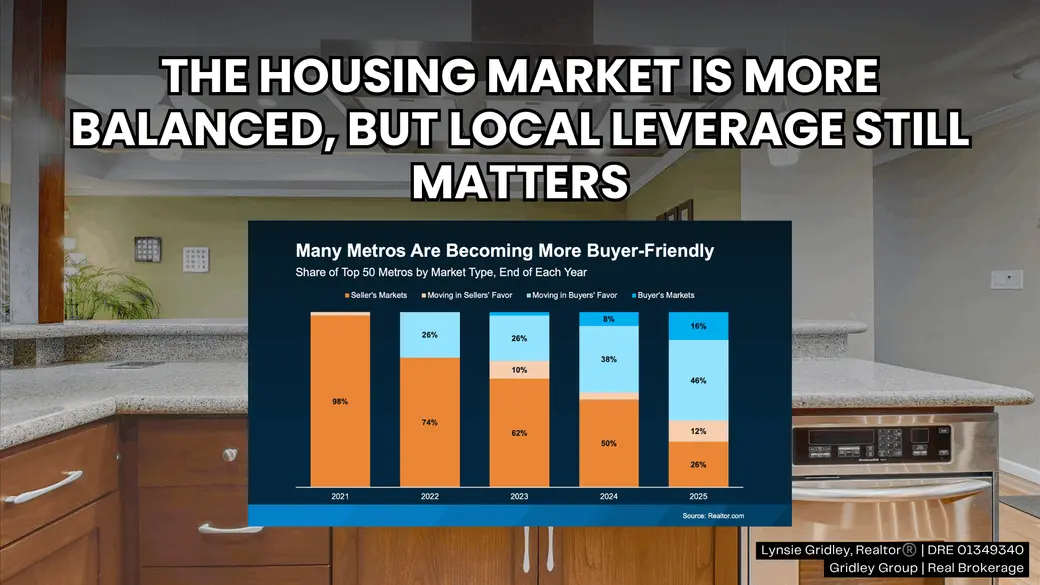
Realtor.com describes the national housing market as balanced and gradually moving in a more buyer-friendly direction.
Using data through December 2025, its Market Clock placed the national market in the balanced and loosening category. Among the 50 largest metropolitan areas, 26 percent were seller’s markets, 46 percent were balanced and loosening, 16 percent were buyer’s markets, and 12 percent were balanced and tightening.
That is a significant shift from the pandemic years, when sellers held the advantage in nearly every major market.
By December 2024, half of the 50 largest markets were still classified as seller’s markets. One year later, that number had fallen to about one quarter.
But San Jose Still Favored Sellers
Here is the local detail that matters most.
In Realtor.com’s latest Market Clock analysis, San Jose remained in the late seller phase. San Francisco was also classified as an early seller’s market.
That means the national shift toward buyers does not automatically describe Silicon Valley.
Inventory remains relatively constrained in many local neighborhoods, and desirable homes can still attract meaningful competition. But buyers are also more selective than they were during the most intense years.
The result is a market where sellers may still hold an advantage, but they cannot assume every home will sell quickly or receive several offers.
What Determines Who Has the Advantage
Market leverage comes down to supply and demand.
A common guideline is the following:
- Fewer than four months of supply often favors sellers
- Four to six months is generally considered balanced
- More than six months often favors buyers
Months of supply estimates how long it would take to sell the available inventory at the current pace of sales.
But even metro-level data can be too broad.
Conditions can vary by city, neighborhood, price range, property type, condition, and school area. One Silicon Valley segment may feel highly competitive while another gives buyers more time and negotiating room.
What Buyers Should Know
Buying in a seller’s market does not mean you need to give up every protection or agree to any price.
It means preparation matters.
Before shopping seriously, buyers should:
- Obtain a strong lender approval
- Understand the full monthly payment
- Review recent comparable sales
- Be ready to act when the right property appears
- Identify which terms can be flexible
- Avoid stretching beyond a comfortable budget
A competitive offer is not simply the highest number.
Sellers may also consider financing strength, deposit, contingencies, closing timeline, and the buyer’s ability to complete the transaction.
Buyers May Still Have More Room Than They Did Before
Even in a market that technically favors sellers, buyers may have opportunities.
A home that is priced too high, needs significant updating, or has been available longer may offer room for discussion.
That could include:
- A price adjustment
- Repair credits
- Help with eligible closing costs
- Included appliances
- Flexible timing
- An approved mortgage rate buydown
The key is knowing when a request is reasonable and when it may weaken the offer unnecessarily.
What Sellers Should Know
Silicon Valley sellers should not assume today’s market behaves like 2021.
Buyers have access to more information, face higher monthly payments, and are comparing homes carefully.
A seller’s market does not protect an overpriced or poorly presented home.
Successful sellers should focus on:
- Pricing accurately from the beginning
- Preparing the home thoughtfully
- Addressing visible maintenance concerns
- Creating strong photography and marketing
- Understanding competing listings
- Evaluating the complete terms of every offer
A home can be located in a seller-favored market and still struggle if the price does not match buyer expectations.
Balance Is Not Bad News for Sellers
A more balanced market can still be productive.
Serious buyers are active, and well-positioned homes can perform strongly. The difference is that buyers may take a little more time and ask more questions.
For sellers, the goal is not to recreate the conditions of the pandemic market.
The goal is to understand today’s buyer and position the home accordingly.
Bottom Line
The national housing market is becoming more balanced, but Silicon Valley has not followed every national trend.
Realtor.com’s latest analysis still classified San Jose as a seller’s market. But leverage varies considerably by neighborhood, price range, property type, and condition.
For buyers, that means being prepared without abandoning good judgment.
For sellers, it means pricing and presentation still matter, even when local supply is limited.
The right strategy starts with understanding the specific market around the home you are buying or selling.
Recent Posts




Her expert knowledge, negotiation, and marketing skills combined with her high level of commitment provide a framework for lasting relationships. Lynsie commits to “Bringing you the Best!”